How Can I Upload a New Version of an Image to Cloudinary Without Change the Url
A better Cloudinary alternative
Integrate with existing setup in minutes without moving images.
Optimize bandwidth and storage costs.
Although we would want everyone to use ImageKit only we understand that one size doesn't fit all. Let united states aid you lot know the difference between ImageKit and Cloudinary so that you can make an informed conclusion based on your present and future requirements.
In example you desire to migrate the storage to ImageKit, checkout ImageKit CLI tool.
Comparison overview
Before you purchase a solution, here is what matters:
| Features Skip to detailed comparison | ImageKit | Cloudinary |
|---|---|---|
| Existent-time image resizing | ||
| WebP and animated WebP support | ||
| Prototype & text overlay | ||
| DPR transformation | ||
| Edge, groundwork, radius, rotate | ||
| Smart cropping | ||
| Automatic format conversion | Requires URL change. Using f-auto parameter. | |
| Automated PNG to JPG optimization | ||
| Custom domain proper name | Included in $49 plan | Included in $249 plan |
| Performance monitoring | ||
| Performance alerts | ||
| Pick to use query parameters for transformations | ||
| Media library | ||
| Video storage | ||
| Video delivery | ||
| Real-fourth dimension video resizing & optimization | ||
| Provisional transformations | ||
| Integrations Skip to detailed comparison | ImageKit | Cloudinary |
| No URL change integration | ||
| Same account for multiple websites | ||
| Remote URL fetch | ||
| Custom CDN integration | ||
| Multiple object storage like S3, Azure, Google Deject, Firebase, Wasabi and other S3 uniform | ||
| HTTP server like Shopify, Magento, WordPress | Requires URL change | |
| CDN and infrastructure Skip to detailed comparison | ImageKit | Cloudinary |
| CDN | CloudFront | Akamai/Fastly |
| Core processing regions | 6 regions bachelor on all plans (Due north California, North Virginia, Singapore, Frankfurt, Sydney, Bombay) | Usa by default Enterprise accounts tin can asking different location i.eastward. Europe and Asia Pacific. |
| Custom CDN integration | Akamai, CloudFlare, Fastly, Azure, Google CDN, Alibaba Cloud CDN, Zenedge or Limelight. Minimal billing $300. | List of CDN support is unknown. Characteristic is bachelor for enterprise accounts. |
| Costing Skip to detailed comparison | ImageKit | Cloudinary |
| Free program | ||
| Start paid plan | $49 per calendar month | $99 per month |
| Overage | $9 per 20GB viewing bandwidth | Side by side program $249 per calendar month |
| Pay as you lot become pricing | ||
| Unlimited image transformations | ||
| Unlimited master images | ||
| Unlimited thumbnail storage | ||
| Technical support Skip to detailed comparison | ImageKit | Cloudinary |
| Most of the fourth dimension, yous won't accept to speak with us, but you volition be impressed with ImageKit support, when you do. Skip to detailed comparison. Here is a screenshot of our Intercom's conversation ratings. Here is what our customer has to say: | ||
| Uptime Skip to detailed comparison | ImageKit | Cloudinary |
| Both services accept exceptional uptime and process millions of images every hour. Uptime won't be a problem for you, no matter which of these two solutions you choose. Skip to detailed comparison. | ||
Pinnacle reasons to choose ImageKit
1. Quick integration
You can complete the integration within x minutes by plugging ImageKit with existing storage instead of moving images to our storage. Integrate with Amazon S3, Firebase, Azure, Wasabi, Google Cloud, WordPress, or Magento to instantly get all real-time resizing and automated optimization.
two. No need to change prototype URL
Setup the same custom domain and outset delivering optimized images. You don't have to add together any parameter in the prototype URL to get quality & format optimization.
3. Easy to employ media library
ImageKit provides a uncomplicated interface to upload, manage, search, and tag resources for efficient digital nugget management in the cloud. Your marketing squad will love information technology.
4. Scalable pricing
Pricing should be uncomplicated to sympathise and predictable. ImageKit charges based on these factors:
- Viewing bandwidth
- Video manipulations operations
- Media library storage
- Avant-garde usage of extensions
All plans include unlimited image manipulations, and thumbnail storage is not charged.
In nigh cases, you will simply dispense media and delivery through our CDN. You pay more when your site traffic increases. Your cost doesn't depend on how many images you lot procedure per month. For case, if yous implement lazy-loading using a low-quality placeholder, the increased number of paradigm transformations won't bear upon your toll in Imagekit.io. Only it will double your transformation in Cloudinary.
five. Superior technical back up
Well-nigh of the time, you won't have to speak with the states, merely y'all will be impressed when y'all do.
half dozen. Faster processing timings
ImageKit has a multi-region image processing network that comes with every plan. It ways, no matter where your original images are stored, first fetch timings will exist minimal.
7 Functioning monitoring
ImageKit has in-built automated operation monitoring and alerting for central business organization pages.
8. Single account for multiple websites
Yous can use a single account for many websites and leverage volume discounts—no fuss almost where and how you apply information technology.
Pinnacle reasons to choose Cloudinary
1. Resize and optimize videos in real-fourth dimension
ImageKit merely supports video commitment and can be integrated with 3rd-party service for other video features. Merely Cloudinary has full support for videos congenital right into the platform.
2. Advanced DAM solution
In Cloudinary, y'all take the option to set folder level permissions to share and edit media assets. The DAM solution is advanced and could be more than suitable if yous desire to move and manage all media assets from Cloudinary.
3. Addons
In Cloudinary, you have addons similar Google vision API to tag images stored in the media library automatically.
Even so not convinced? Let's get into the details.
Feature comparison
Both products have been around for a long time and have all the features y'all need to shop, resize, and deliver optimized images within milliseconds. However, each has certain unique advantages that could make your life easy, depending upon your use-cases.
Paradigm manipulation
ImageKit has more than twoscore URL parameters for image manipulation. You tin can dynamically conform images equally you desire to fit the layout. Cloudinary has unique features like conditional transformations and injecting a custom function into the paradigm transformation pipeline.
Here, ImageKit has a unique advantage. You lot can add transformation string as part of the query parameter in addition to the URL param. This is useful when you don't desire to change URL structure.
For example:
<!-- In Imagekit.io, both will work--> < img src = " https://ik.imgkit.net/demo/image.jpg?tr=w-300 " > </ img > < img src = " https://ik.imgkit.net/demo/tr:westward-300/paradigm.jpg " > </ img > <!-- In Cloudinary, just ane will work --> < img src = " https://res.cloudinary.com/demo/image/upload/w_300/image.jpg " > </ img > Let'due south see how prototype manipulation works in ImageKit:
Prototype optimization
Both offer the same level of compression as both solutions leverage tried and tested industry standard encoding algorithms.
However, ImageKit is more developer friendly. It will always compress images by default. You don't accept to change the URL to leverage automatic prototype optimization.
In Cloudinary, y'all will accept to add f_auto parameter in every URL to make it work. Otherwise, the format is not inverse based on browser support.
Let'due south see how automatic paradigm optimization works in ImageKit:
Performance monitoring & alerting
This feature is unique to ImageKit. You lot will get an in-depth image optimization report for central business concern pages delivered to your inbox. This allows your squad to proactively gear up issues without having to check generic web-performance reports in tertiary party tools manually.
- Get actionable advice that will fix performance problems immediately.
- Automatic daily analysis on desktop and mobile devices.
- Performance insights delivered to your inbox.
Media library
ImageKit has a simple interface to upload, manage, search, and tag resources for efficient digital asset management in the cloud. Your marketing team will love it.
Cloudinary'due south media library has many avant-garde features like automatic tagging, folder level permission for sharing & editing media avails. Information technology might be overwhelming in the beginning, but yous will get used to it over some time. It has everything y'all need.
ImageKit unique advantage is that it has co-located storages in all 6 geographic regions. It has two benefits:
- It volition meliorate your start fetch timings. The processing server is in the same AWS region where the image is stored. The download timings are minimal, and your data doesn't even get out AWS datacenter.
- Information technology will help you with GDPR compliance. For instance, if yous cull the Frankfurt region, your assets will be stored in but the Frankfort region.
Hither is how the media library works in ImageKit:
Analytics
ImageKit has powerful analytics that allows you to track everything necessary from one place. You will become the following reports in ImageKit:
- Top 404 URLs - Proactively identify and fix image URLs that return 404 errors earlier your users written report them.
- Daily bandwidth and asking usage graph (with and without imagekit)
- Top images based on request & bandwidth
- Superlative image transformations
- Country reports
- Referral reports
Cloudinary too has all the necessary reports. Yous also accept the option to export the CSV.
Integration comparing
ImageKit is built to integrate with the existing setup in minutes.
A few advantages of ImageKit are:
- No URL change required - setup the same custom domain and kickoff delivering optimized images. It comes with a paid plan, which is $49 per calendar month.
- Connect with any object storage - Native integration with Amazon S3, DigitalOcean Spaces, Google Deject Storage, Firebase, Ali storage, Wasabi, and other S3-compatible storages. Available on all plans.
- Integrate with any web server - Attach whatsoever public server or load balancer e.one thousand. Magento, WordPress, Shopify, AWS EC2 or ELBs. Bachelor on all plans.
- Fetch any remote URL - Optimize & transform any public epitome through ImageKit using Web Proxy origin. Available on all plans.
- Manage multiple websites in the same account - Add multiple external storage and access them on unique URL endpoints. Available on all plans.
- Use in-built AWS CloudFront or your CDN - Integrate with Akamai, CloudFlare, Fastly, Azure, Google CDN, Alibaba Cloud CDN or Limelight. Information technology comes with a minimum monthly billing of $300.
In Cloudinary, enterprise customers can choose to store their raw assets on their ain deject storage. It does non offering native integration with object storage. You volition have to upload raw assets to Cloudinary to commencement using image manipulation and optimization.
Infrastructure comparison
Both solutions use established Global CDN and tin can serve cached images in sub-milliseconds.
However, ImageKit has the reward of a multi-region cadre processing network, which decreases the response time for new transformations and increases overall uptime.
ImageKit was the kickoff i to offer multi-region co-located storage.
| ImageKit | Cloudinary | |
|---|---|---|
| CDN | Amazon CloudFront | Akamai/Fastly |
| Core processing locations | 6 regions bachelor on all plans (N California, Due north Virginia, Singapore, Frankfurt, Sydney, Mumbai) | US. Enterprise accounts can asking different location i.e. Europe and Asia Pacific. |
Pricing comparison
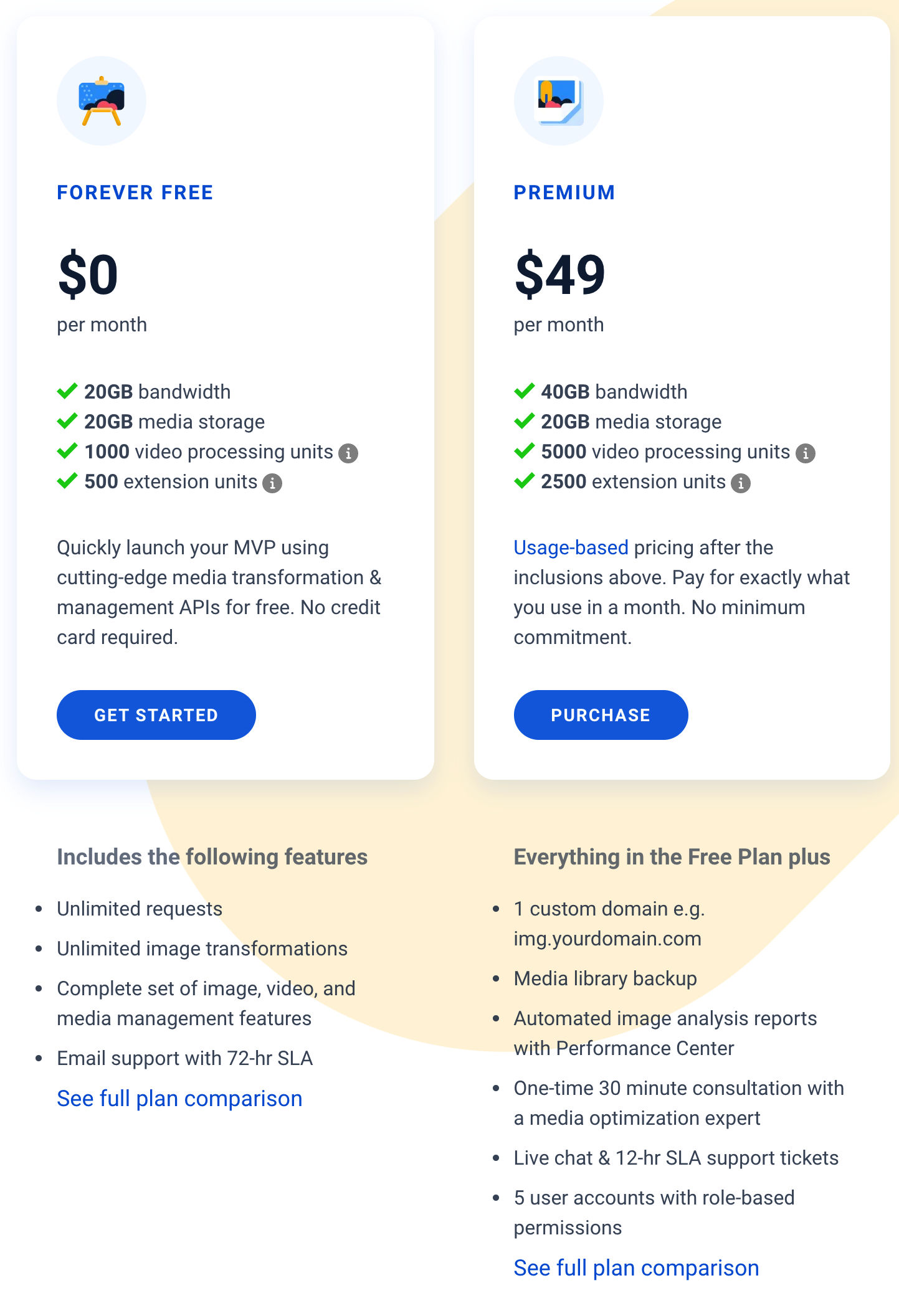
ImageKit has a anticipated and simple to understand pricing model. In most cases, your monthly toll depends on viewing bandwidth. If yous use advanced features such as video manipulation or extensions, yous pay as per actual usage.
Few adept points nearly ImageKit pricing:
- Free plan option.
- Small overage unit. Information technology means your cost increases proportionally to your site traffic.
- Unlimited master images.
- Unlimited image transformations.
- Unlimited thumbnail storage.
Apart from bandwidth inclusions, the divergence betwixt free and paid programme is:
- I custom domain name e.g.
images.case.com. - One time 30 min consultation phone call where we volition cover how y'all can improve website performance and user experience.
- Media library backup.
- Automatic performance monitoring and alerting.
- Live conversation back up.
- User management.
Cloudinary also has a complimentary plan. The first paid program starts at $99, and the adjacent programme is $249 per month. You get a fixed amount of credits which volition be used confronting:
- Monthly Transformations - Number of all newly processed assets, including original uploads and derivatives (images and video-frames) within the last 30 days.
- Managed Storage - The accumulated size of all of your assets, which are stored on your Cloudinary account.
- Monthly Internet Viewing Bandwidth - Full bandwidth of content delivered from your business relationship within the concluding thirty days.
Understanding how credits will exist used tin quickly become disruptive.
Here ImageKit has a clear advantage. Not only in terms of simplicity and staring toll simply as well how the cost volition abound in the time to come. Let's understand that with examples.
How will your cost increase in the hereafter?
It is crucial to sympathise how the costing will abound in the future when your team starts using a service for dissimilar use-cases. You should avoid being in a situation where you are stuck with a third party solution and paying more than a reasonable amount of money every calendar month.
To understand how cost will grow, allow's compare the free program limits:
| Component | ImageKit | Cloudinary |
|---|---|---|
| Viewing bandwidth | 20GB | 20GB |
| Monthly image transformations | Unlimited | 20,000 |
| Thumbnail storage | Unlimited | 10GB |
| Total Images & Videos | Unlimited | 300,000 |
In ImageKit, the beginning paid program starts at $49, which includes 40GB. When you cantankerous 40GB per month, your cost increases at $9 per 20GB extra. The volume discount starts in one case your monthly billing reaches $300.
In Cloudinary, the first paid plan starts at $99, which includes 225 credits. The adjacent plan starts at $249 per month. Credits are used confronting monthly transformations, managed storage, and viewing bandwidth.
Now let's consider different scenarios to empathize how various components change monthly costing.
Your squad implemented responsive images
Your folio views increased
You decided to use depression quality placeholders
Uptime comparison
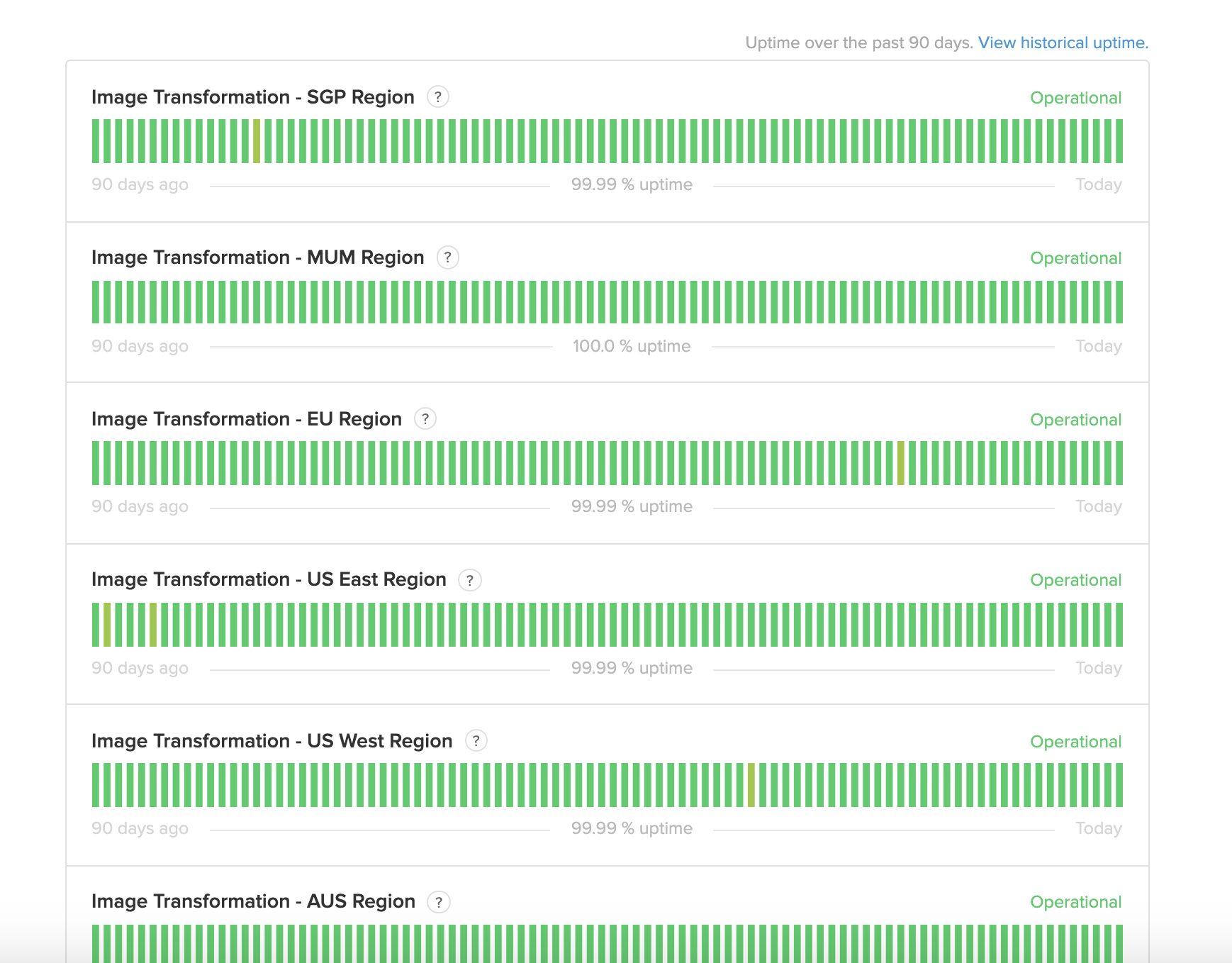
Both services have exceptional uptime and process millions of images every hour. Uptime won't be a problem for you, no thing which of these 2 solutions you choose.
Notwithstanding, ImageKit has a unique advantage here. 6 image processing regions human activity as a failover for each other if ane region goes down. This type of distributed compages not only improves the TTFB for first paradigm fetch but also brand ImageKit more bachelor. ImageKit is committed to expanding its infrastructure in other regions in the future.
Too, based on the status pages, ImageKit seems to be more transparent nigh past incidents. You volition exist able to run across recent uptime reports for different regions from a single view without farther excavation.
Support comparing
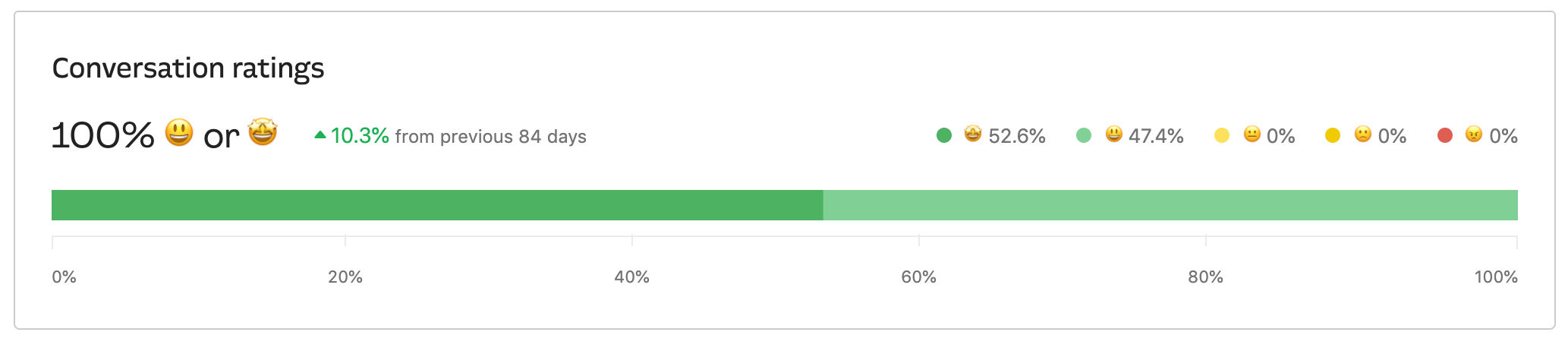
ImageKit offers live chat support. You can initiate a conversation with us from the dashboard, docs, or any page on the website. You lot will get expert advice from bodily engineers.
Here is a screenshot of our Intercom's chat ratings.
ImageKit SDKs
ImageKit offers SDKs for all popular programming languages.
Yous can apace implement URL generation and file upload with a few lines of code.
React
Angular
Vue.js
Android (kotlin)
Android (java)
Javascript
Python
Node.js
Carmine and ROR
Java
PHP
.NET
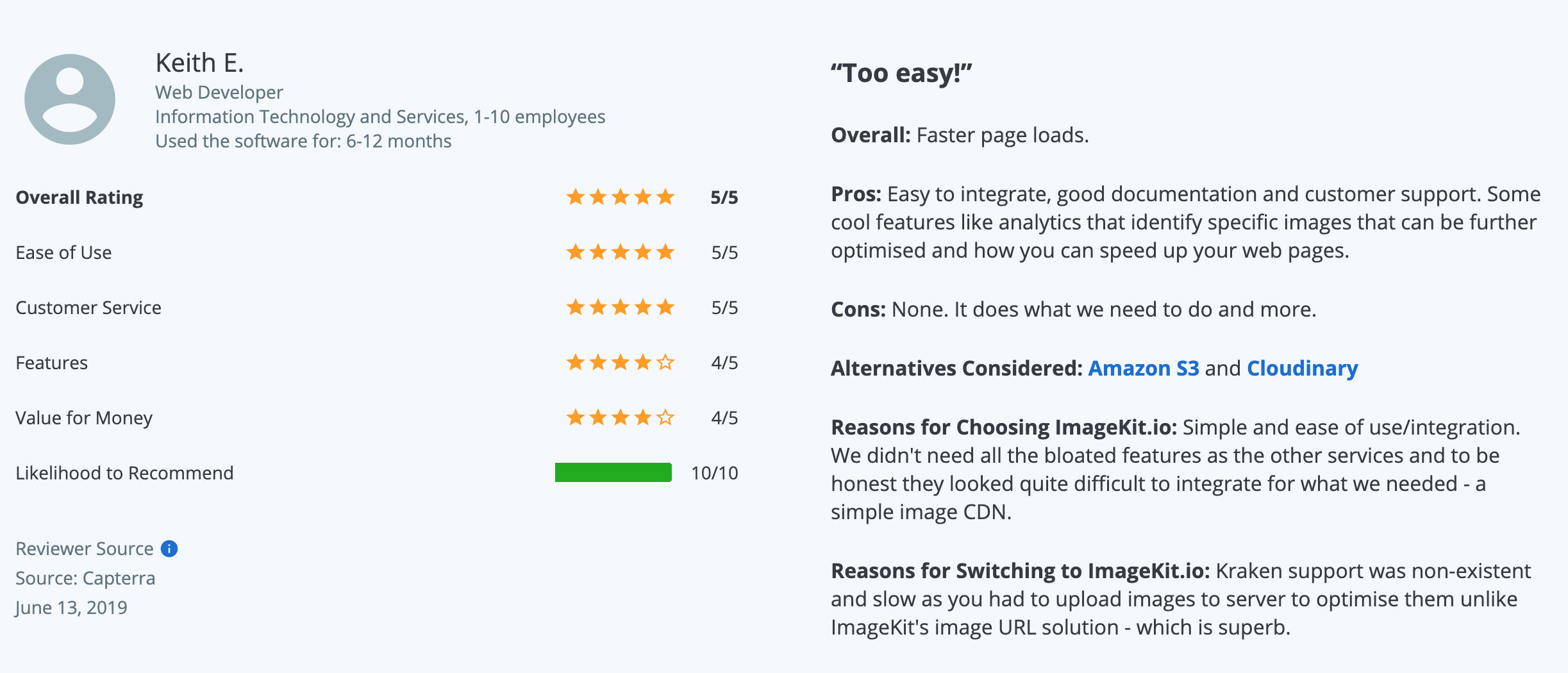
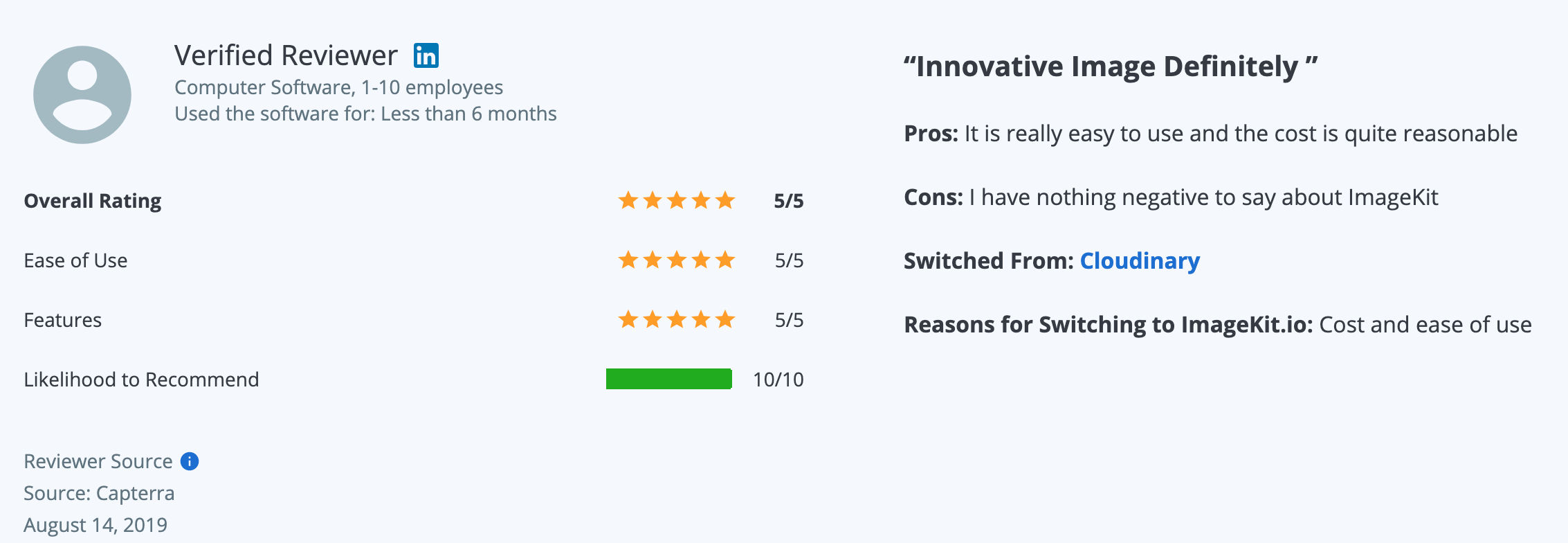
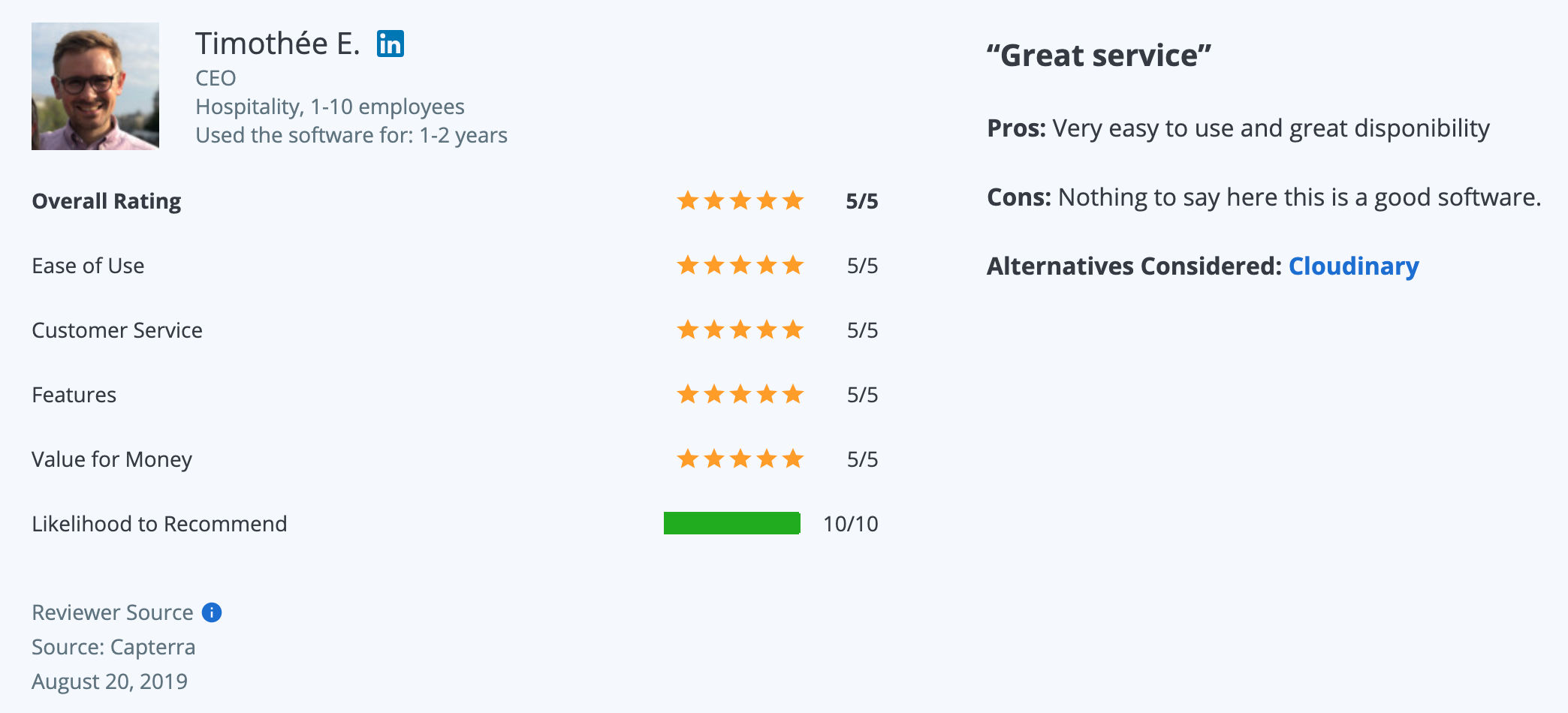
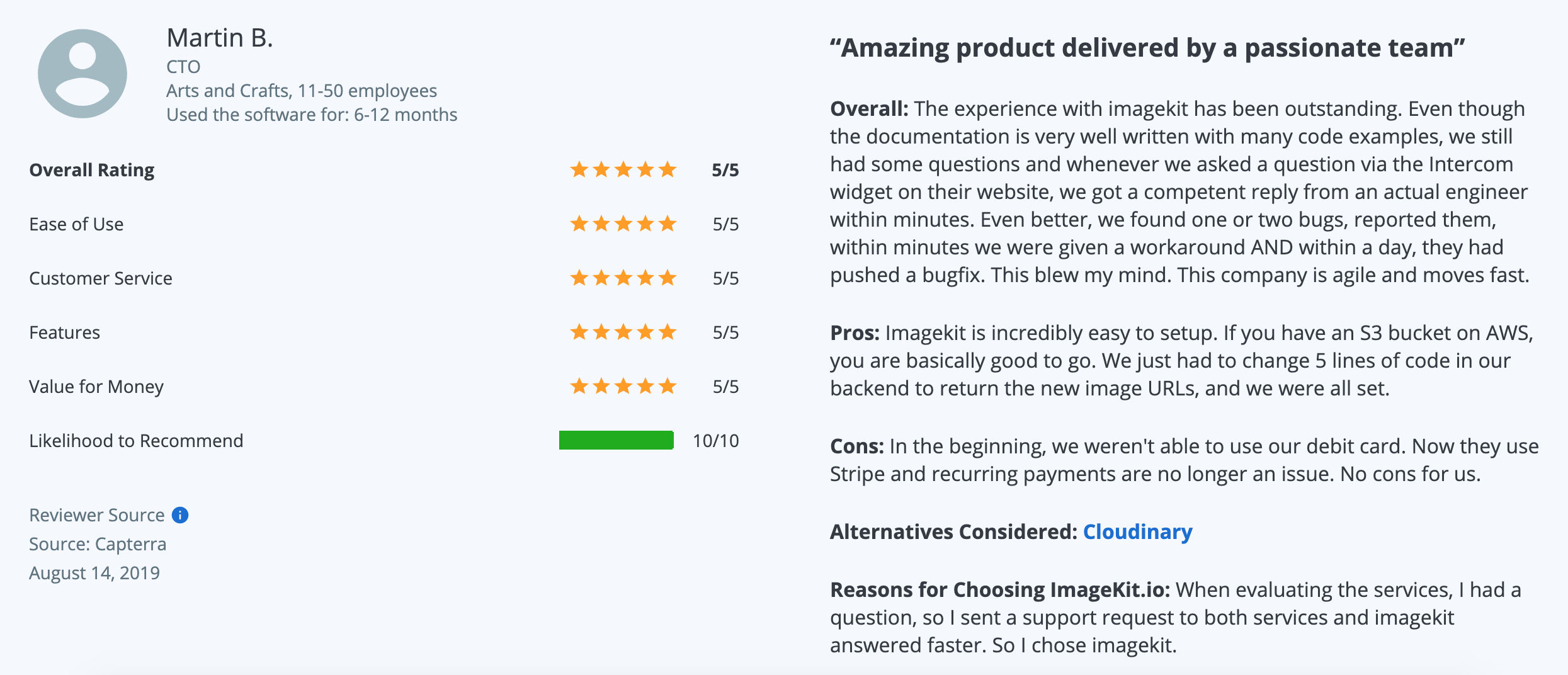
// In society to use the SDK, you need to provide it with a few configuration parameters. // The configuration parameters can exist applied directly to the IKImage component or using // an IKContext component. < IKContext publicKey = " your_public_key " urlEndpoint = " your_url_endpoint " transformationPosition = " path " authenticationEndpoint = " http://www.yourserver.com/auth " > // Image component < IKImage path = " /default-prototype.jpg " transformation = { [ { "height" : "300" , "width" : "400" } ] } /> // Image upload < IKUpload fileName = " my-upload " /> </ IKContext > // In guild to apply the SDK, you lot need to provide it with a few configuration parameters. // The configuration parameters must be passed to the ImagekitioAngularModule module // in your app.module.ts file. @ NgModule ( { declarations : [ AppComponent ] , imports : [ BrowserModule , AppRoutingModule , ImagekitioAngularModule . forRoot ( { publicKey : "your_public_key" , // or environment.publicKey urlEndpoint : "your_url_endpoint" , // or environment.urlEndpoint authenticationEndpoint : "http://www.yourserver.com/auth" // or environment.authenticationEndpoint } ) ] , providers : [ ] , bootstrap : [ AppComponent ] } ) // Image render using path < ik-prototype path = " /default-epitome.jpg " transformation = { [ { "height" : "300" , "width" : "400" } ] } > </ ik-image > // Simple upload < ik-upload fileName = " my-upload " /> </ ik-upload > // Upload using callbacks and other parameters of upload API < ik - upload fileName = "test_new" [ useUniqueFileName ] = "false" [ isPrivateFile ] = "truthful" ( onSuccess ) = "handleUploadSuccess($upshot)" ( onError ) = "handleUploadError($upshot)" > </ ik-upload > // In order to employ the SDK, y'all need to provide it with a few configuration parameters. // The configuration parameters can be applied directly to the IKImage component or using an IKContext component. < IKContext publicKey = " your_public_key " urlEndpoint = " your_url_endpoint " transformationPosition = " path " authenticationEndpoint = " http://www.yourserver.com/auth " > // Paradigm component < IKImage path = " /default-prototype.jpg " transformation = { [ { "meridian" : "300" , "width" : "400" } ] } /> // Image upload < IKUpload fileName = " my-upload " /> </ IKContext > import com . imagekit . android . ImageKit ; ImageKit . init ( context = applicationContext , publicKey = "your_public_key" , urlEndpoint = "your_url_endpoint" , transformationPosition = TransformationPosition . PATH , authenticationEndpoint = "http://www.yourserver.com/auth" ) // your_url_endpoint/default-image.jpg?tr=h-400.00,ar-3-2 ImageKit . getInstance ( ) . url ( path = "default-paradigm.jpg" , transformationPosition = TransformationPosition . QUERY ) . height ( 400f ) . aspectRatio ( 3 , 2 ) . create ( ) // File upload ImageKit . getInstance ( ) . uploader ( ) . uploadImage ( file = bitmap !! , fileName = filename , useUniqueFilename = false , tags = arrayOf ( "squeamish" , "copy" , "books" ) , folder = "/dummy/folder/" , imageKitCallback = this ) import com . imagekit . android . ImageKit ; ImageKit . Companion . init ( getApplicationContext ( ) , "your_public_key" , "your_url_endpoint" , TransformationPosition . PATH , "http://www.yourserver.com/auth" ) ; // your_url_endpoint/default-image.jpg?tr=h-400.00,ar-3-2 ImageKit . Companion . getInstance ( ) . url ( "default-image.jpg" , TransformationPosition . QUERY ) . height ( 400f ) . aspectRatio ( three , 2 ) . create ( ) // File upload ImageKit . Companion . getInstance ( ) . uploader ( ) . uploadImage ( bitmap , filename , false , // useUniqueFilename new String [ ] { "overnice" , "copy" , "books" } , // tags, "/dummy/binder/" , imageKitCallback ) // SDK initialization var imagekit = new ImageKit ( { publicKey : "your_public_key" , urlEndpoint : "your_url_endpoint" , authenticationEndpoint : "http://world wide web.yourserver.com/auth" , } ) ; // URL generation var imageURL = imagekit . url ( { path : "/default-image.jpg" , transformation : [ { "tiptop" : "300" , "width" : "400" } ] } ) ; // Upload office internally uses the ImageKit.io javascript SDK function upload ( information ) { var file = document . getElementById ( "file1" ) ; imagekit . upload ( { file : file . files [ 0 ] , fileName : "abc1.jpg" , tags : [ "tag1" ] } , function ( err , result ) { console . log ( arguments ) ; panel . log ( imagekit . url ( { src : result . url , transformation : [ { acme : 300 , width : 400 } ] } ) ) ; } ) } # SDK initialization from imagekitio import ImageKit imagekit = ImageKit ( private_key = 'your_private_key' , public_key = 'your_public_key' , url_endpoint = 'your_url_endpoint' ) // SDK initialization var ImageKit = crave ( "imagekit" ) ; var imagekit = new ImageKit ( { publicKey : "your_public_key" , privateKey : "your_private_key" , urlEndpoint : "your_url_endpoint" } ) ; # Add this lawmaking to config/initializers/imagekitio.rb ImageKitIo . configure do | config | if Rails . env . evolution ? config . public_key = 'your_public_key' config . private_key = 'your_private_key' config . url_endpoint = 'your_url_endpoint' # https://ik.imagekit.io/your_imagekit_id end config . service = :carrierwave # supervene upon with ':active_storage' if using ActiveStorage for uploads # config.constants.MISSING_PRIVATE_KEY = 'custom fault message' terminate #make sure to replace the your_public_key, your_private_key and your_url_endpoint with bodily values # post-obit sections just employ if you're using the ActiveStorage functionality # run the following commands on terminal in your project directory rails active_storage :install rails db :migrate # add the post-obit to config/storage.yml imagekitio : service : ImageKitIo # add the following to config/environments/evolution.rb config . active_storage . service = :imagekitio // Create a config.properties file inside src/chief/resources of your project. // And put essential values of keys (UrlEndpoint, PrivateKey, PublicKey), no demand to use quote // in values. Then you need to initialize ImageKit with that configuration. // UrlEndpoint=your_url_endpoint // PrivateKey=your_private_key // PublicKey=your_public_key import io . imagekit . sdk . ImageKit ; import io . imagekit . sdk . config . Configuration ; import io . imagekit . sdk . utils . Utils ; form App { public static void main ( String [ ] args ) { ImageKit imageKit = ImageKit . getInstance ( ) ; Configuration config = Utils . getSystemConfig ( App . class ) ; imageKit . setConfig ( config ) ; } } // SDK initialization use ImageKit \ ImageKit ; $imageKit = new ImageKit ( "your_public_key" , "your_private_key" , "your_url_endpoint" ) ; // SDK initialization using Imagekit ; Imagekit . Imagekit imagekit = new Imagekit . Imagekit ( "your_public_key" , "your_private_key" , "your_url_endpoint" , "path" ) ; Hither is what our customers take to say:
Conclusion
If you scrolled as well chop-chop, here is what y'all demand to know:
- Cull ImageKit for image and video manipulation, optimization, storage & delivery.
- Choose Cloudinary if you lot need adaptive bitrate streaming for videos. ImageKit's video API will shortly take back up for ABS. See the documentation for the latest information.
Delight achieve out to usa at support@imagekit.io, in case you lot have any questions.
Source: https://imagekit.io/cloudinary-alternative/

Post a Comment for "How Can I Upload a New Version of an Image to Cloudinary Without Change the Url"